|
Banjo, Banjer, Banjar!
The album notes included with the CD Full Circle: The Solo Banjo Sessions refer to all three of these various musical instruments, so it’s worth a minute to explain why one thing comes to have three names.
In fact, the banjo didn’t have a common name until sometime in the second or third quarter of the 19th Century. Before then, its name and the method of its construction varied from place to place. Because its design originated within several African tribal societies, there was considerable inconsistency of size, shape and stringing among the first American banjos. Everywhere, however, it was made from a gourd, with a wooden neck attached, and three or more strings. In the American South, the Caribbean and northern South America its title was variously recorded as bangie, banjar, banjer, bania, banshaw -- and also merriwang.
Nobody much plays the merriwang anymore.
Even after the word "banjo" codified the instrument that we know today, regional variations in accent and dialect have ensured that there are welcome differences. In some parts of the American South, where it achieved popularity among rural white musicians, it’s often called a "banjer": elsewhere, a "banjar." Bob's friend and musical partner Curt Bouterse in San Diego, California put the matter into a logical, emotional form:
"I prefer to use the spelling banjer because it corresponds most closely to what the instrument has traditionally been called by those who developed and played it.... There is every reason to believe that, in this case at least, it is the ‘cultivated’ pronunciation which is the non-standard.... Now, if you want to go down to the music store and buy an assembly-line contraption with a plastic head, made out of aluminum, plastic, and chromed steel, that weighs enough to give you a hernia, you’re welcome to call that a ‘banjo,’ but my Frank Proffitt fretless is a banjer."
--Curtis Carlisle Bouterse, "Idiosyncratic Note on Banjo/Banjer" in Nixon’s Farewell & Ten Other Newly Made Old Time Banjer Tunes in Traditional Style (San Diego: privately published, 1979), n.p. http://home.earthlink.net/~curtis.carlisle.bouterse/banjers
Nomenclature and etymology aside, the history of the banjo tells of its arrival in the Americas in the minds of Black artists who survived slave-transport by ship from Africa. The instruments they made (often outlawed by plantation overseers) were constructed of purpose-grown gourds hollowed out and fitted with animal skin heads, joined to necks of wood with three or more strings of metal or animal gut. These gourd-banjos were described by white observers from the 1700s onward, and at least one professional actor, Gottlieb Graupner, apparently played a "banjo" on stage in Boston, Massachusetts and in London, England during 1799. By the 1830s, a few professional white performers had incorporated the instrument into their stage presentations of "Negro" culture. Then, in 1843, the banjo burst on the scene as one of the obligatory instruments of the "minstrel show," a serio-comic theatrical entertainment that took the United States by storm. Within a year or two, the minstrel show and its antic theatrical style, which included the gyrations of a banjo-player, became America’s first "pop" culture event. The social explosion that ensued was every bit as big as Elvis Presley in the 1950s; or The Beatles in 1964.
Northern minstrel banjoists had no access to gourd-growing technology, so they approached drummakers to build an analog body of wood that would serve the same function as the gourd. The early banjos from the 1840s were the prototypes for everything that came afterward, right to the modern factory-made banjos of today. By the time the term "banjo" was codified, it referred specifically to a five-string instrument, with a wooden body bent into a circle and fitted with a tension hoop and hooks that held down a skin head. The neck was fitted with four long melody strings and a short fifth string, a drone that fastened to a peg about two-thirds of the way up the neck on the bass side.
Before the Folk Revival many people thought the banjo was a four-stringed instrument played with a plectrum, a flat-pick, in what is now called "traditional jazz" and dance-band music. The preeminent five-string banjo-player Pete Seeger reported that around 1940 he had trouble finding sets of strings for his instrument. Everyone else played tenor and plectrum banjos, and they only had four strings. A generation of us were surprised to learn that the plectral instruments were modern derivatives of the old kind of banjo, the five-stringer that had been made in one form or another since the 1830s.
Many websites offer information, as well as a certain amount of misinformation and folklore about the origins of the banjo. Some "historians" try to detach it from its African roots, while others erroneously credit a white man, Joel Walker Sweeney of Virginia, for having "invented" the five-string banjo. The only thing certain about the early history of the banjo is that Afro-American musicians and banjomakers transmitted the idea to certain white artists who responded to the appeal of tribally-based polyphonic dance music. Unfortunately, the instrument itself soon became entwined in the debate over slavery. Within a decade of its introduction into white society, the banjo became iconic, like the juicy watermelon and the huge-eyed Black child, as a symbol of "Jim Crow" and racism in America.
For more information read Ring the Banjar!: The Banjo in America from Folklore to Factory (Anaheim Hills, California: Centerstream Press, 1996). Bob wrote it in 1984 as the monograph to accompany the museum exhibition of the same name that he developed and curated for the MIT Museum in Cambridge, Massachusetts. The exhibition and the publication seem to have started something, because we are now celebrating another "golden age" of banjomaking and banjo-playing.
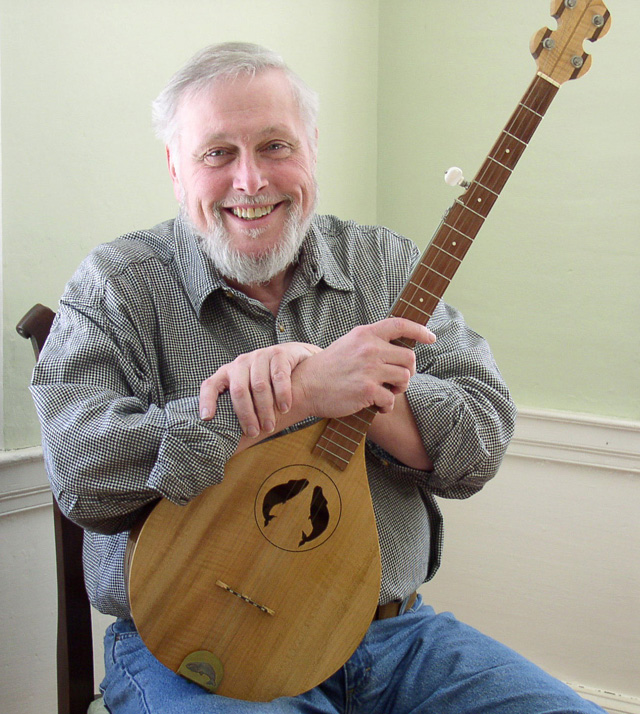 Full Circle: The Solo Banjo Sessions includes music performed on banjos, banjers and banjars: six instruments in all, including a Fairbanks-Vega "Tu-ba-phone" No. 9 built in Boston in 1911; a Bacon & Day Silver Bell Special from about 1928; an Appalachian fretless "banjer" made by Clifford Glenn in North Carolina; a small Ozark-style wooden-headed banjer made by Curt Bouterse (short enough to fit in a old-style fiddle "coffin" case); a gut-strung William Boucher minstrel-banjo replica crafted to high standards by James Hartel in Franklin, New York; and a "mandoline-banjo" made by Mikael Carstanjen in the 1970s: it has a regular five-string neck fitted to a teardrop-shaped mandola body made of wood. The sound of each is unique, and hopefully makes Full Circle accessible even to folks who don’t normally like two banjo tunes played back-to-back! Full Circle: The Solo Banjo Sessions includes music performed on banjos, banjers and banjars: six instruments in all, including a Fairbanks-Vega "Tu-ba-phone" No. 9 built in Boston in 1911; a Bacon & Day Silver Bell Special from about 1928; an Appalachian fretless "banjer" made by Clifford Glenn in North Carolina; a small Ozark-style wooden-headed banjer made by Curt Bouterse (short enough to fit in a old-style fiddle "coffin" case); a gut-strung William Boucher minstrel-banjo replica crafted to high standards by James Hartel in Franklin, New York; and a "mandoline-banjo" made by Mikael Carstanjen in the 1970s: it has a regular five-string neck fitted to a teardrop-shaped mandola body made of wood. The sound of each is unique, and hopefully makes Full Circle accessible even to folks who don’t normally like two banjo tunes played back-to-back!
These twenty one tracks are the best of more than seventy Bob recorded from August 2006 to February 2007 at Night Sail Studios in Windsor, Maine. His friend and musical colleague David Peloquin captured and mixed what is essentially a "live" album—Dave didn’t employ any of his studio magic (other than overdubbing a few guitar accompaniments). What you hear is what you might experience if Bob played over to your house after supper. The music is all about emotion and energy, so if you listen really carefully on a good system, you may hear his fingernail occasionally snag a string, or a few off-rhythm "ticks" created when he hammered-on a note.
About Banjo Tunings
On Full Circle: The Solo Banjo Sessions, Bob used a variety of tunings. Tunings are much more important to frailing (clawhammer) banjoists than to other stringed-instrument players. Some old-time tunes are difficult or impossible to play in anything other than one specific tuning. A few, like "Last Chance," are so dependent upon a special tuning that the tuning itself is named after the tune.
In the 19th-Century, the "standard" tuning for the five-string banjo was gCGBD. That is to say, the short drone string was tuned to G an octave above the third string. The bass (4th) string is tuned to C, the 3d string to G, 2nd to B, and 1st string, the highest-pitched full-length string, to D. That tuning puts the instrument into the home key of G, but to get the G major chord, the player must set his finger at the second fret of the 4th (bass) string, thus raising its pitch from C to D. A few old-time tunes are played in the old standard-G tuning, but it's mostly used now to re-create the music of minstrel-show banjo players.
G Tuning - gDGBD
Players in the Southern Appalachian Mountains soon enough brought the bass string up to D and left it there: making gDGBD. By doing so, it became possible to strum a G major chord without fretting any string. Nowadays, this is the "standard" G tuning used by both bluegrass and old-timey pickers.
Bob used gDGBD twice on Full Circle, for "Swannanoa Tunnel" and "Policeman". But beware: when describing tunings used on the CD, it means only the relative intervals between the strings: the actual pitch may come out somewhere else than the key for which the tuning is named -- particularly when playing low-tension fretless banjos, or those with gut strings.
"Incomplete" or "Double" C Tuning - gCGCD
For clawhammer players, the most useful tuning is what's called "C" tuning, and it comes in two forms, the so-called "incomplete" or "double" C tuning, and the "full" C tuning. "Double" C is formed in this way: beginning from standard G tuning (gDGBD), the bass (4th) string is dropped back to its 19th-Century tuning of C. Then the 2nd string is raised from B to C, thus creating gCGCD. Now the banjo is pitched in the key of C, and the C major chord is produced by fretting the 1st string at the second fret.
"Double" C tuning was used on "Meggie," "Diamond Joe," "The Cowboy Waltz," "Liza Jane," "Fall on My Knees," "Rocky Hill," "When Johnny Comes Down to Hilo," and "The Unfortunate Tailor."
"Full" C Tuning - gCGCE
"Full" C tuning is accomplished from "incomplete" C by tuning the first string from D to E, creating gCGCE. Now you can strum a C chord without fretting, but you lose the ability to perform some of the delicate hammer-ons and pull-offs on the 1st string that characterize the "incomplete" C tuning. this open tuning was used to play "Charleston."
"Mountain Minor" (G modal) Tuning - gDGCD
Much of the haunting character of the "high lonesome" sound is made by re-tuning to so-called "modal" tunings. From "incomplete" C, gCGCD, tune the bass (4th) string up from C to D (as we did to get to modern "G" tuning). This is the most useful and most common of the modal tunings for the banjo, even though it has no minor in it. It pitches the banjo in the key of G, but in a modal form.
"Mountain Minor" produces many of the deeply haunting sounds on Full Circle: listen to "Nine Hundred Miles,," "East Virginia," "Fast-moving Clouds," "Lady of Carlisle," "Red Rocking Chair," and "The Cuckoo Bird." Note that on "Fast-moving Clouds," the "hauntiness" is increased by down-tuning the bass (4th) string from D to G an octave below the 3rd string. It's difficult to do this unless you have a good instrument with new strings that will hold this low pitch. But the tune works easily without the low bass. Bob wrote it in conventional "Mountain Minor" tuning, and it can easily be played that way.
D Tuning - f#DF#AD
Tuning the banjo to the open key of D is rarer, but extremely useful. Both the D major tuning and the D modal tuning are exciting to play and to hear. Beginning from standard G tuning, gDGBD, the D major tuning is accessed by dropping the drone string a half-step from G to F#, and dropping the two inside melody strings —3rd string to F# and 2nd string to A. By lowering the pitch of these three strings you reach f#DF#AD. This D tuning tuning is commonly heard in railroad songs like "Reuben's Train."
Bob played in D tuning on the medley of "Protect the Innocent" and "Tilden" on Bank Trollers; but see also the note below concerning "Coal Creek March" on Full Circle.
D Modal Tuning - f#DGAD
The D modal tuning may cast a bigger spell than any other: Bob used it on "Wild Bill Jones." It's made by taking the third tone out of the scale. From standard modern G tuning (gDGBD), the 2nd string is down-tuned from B to A, and the drone (5th) string down-tuned from g to f#, giving f#DGAD.
"Last Chance" Tuning - fDFCD
"Last Chance" is one of those tunes that is so peculiar that it requires a special tuning to play it properly. There may not be more than two or three banjo tunes ever played in this special tuning, but it's needed for them. The tuning is fDFCD. The 5th and 3d strings are tuned down one full tone from standard G tuning (gDGBD), and the 2nd string is tuned up a half-step.
To Summarize...
People have variously written that there are 27 tunings for the five-string banjo, or 86, or some other number. You can experiment making your own: as Pete Seeger once said, "There are no notes to a banjo: you just play it!"
About "Coal Creek March": Bob first heard Art Rosenbaum play this fine tune late in 1963 or early in 1964, on the Elektra LP album Folk Banjo Styles (EKL-7217). He later had the opportunity to hear Pete Steele, Art's original source, perform it on Banjo Tunes and Songs (Folkways FS 3828).
When he sat down with David Peloquin they intended to create a memory-catalogue of all the banjo tunes he knew. While sitting with the wooden-bodied "mandoline-banjo" loaned to him by Don Sineti, "Coal Creek March" dropped unbidden into the microphones. While he recalled playing it in an unusual tuning, neither he nor Dave made a note of what tuning it was. His best guess was that the instrument was in D Tuning (f#DF#AD), but not tuned to "concert" pitch. Then he had it capoed up, probably two frets.
Tablature
Three tunes from Bob's CDs are here written in standard banjo tablature. These are not note-for-note transcriptions, but rather arranged for the advanced beginner to intermediate-level player. All of the various techniques he employed are present, including drop-thumb or double-thumb frailing; hammering-on, pulling-off, and the use of the fifth-string to produce quarter-notes in certain measures.
"Handsome Molly" may be heard on Bank Trollers, and "Rocky Hill" and "When Johnny Comes Down to Hilo" are included on Full Circle: The Solo Banjo Sessions.
"Handsome Molly" PDF
"Rocky Hill" PDF
"When Johnny Comes Down to Hilo" PDF
|
